Serviceberry Blooms
Serviceberry Blooms
22/72: Apr 15 to 19
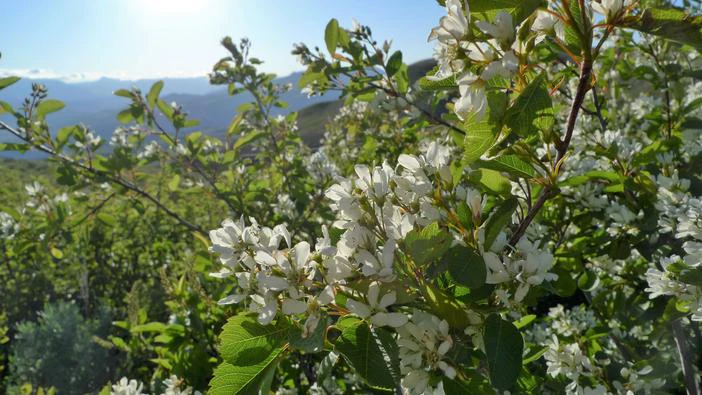
Serviceberry blooms like scattered snow. White petals in the upland sun.

風物詩 · Fūbutsushi
Serviceberry flowering on a dry hillside in April — clusters of white five-petaled blossoms against bare branches, the upland country's first snow-white flower.
物の哀れ · Mono no Aware
The white flowers fall within a week, replaced by hard green berries that will take all summer to ripen. The bloom is the briefest part of the long wait.
What the season brings?
Mid-April brings the flowering of western serviceberry (Amelanchier alnifolia), a deciduous shrub that produces clusters of delicate white five-petaled flowers in upland areas and dry forests throughout the Pacific Northwest. Also known as Saskatoon berry, this plant blooms earlier at lower elevations and progressively later as you climb in elevation, creating a wave of white blooms moving up mountainsides through late spring. The flowers attract numerous native pollinators including mason bees, bumblebees, and butterflies. By mid to late summer, the flowers develop into small, apple-like berries that turn purple-black when ripe and were one of the most important traditional foods for indigenous peoples across western North America. Modern foragers still prize these sweet berries for fresh eating, pies, and preserves, and they remain culturally significant to many tribes.
Convergence chain
Triggered by
Amelanchier alnifolia blooms when temperatures cross 12°C and day length is sufficient; one of the earliest white-flowered shrubs of spring, appearing while oak and maple are still leafing out; its early timing serves species that cannot access tubular flowers
Enables
Serviceberry flowers support pollinators that can't access tubular red flowers — most bee species, syrphid flies, beetles; berries in July are critical refueling stops for southbound migrating songbirds; Lewis's woodpeckers cache serviceberries in bark crevices as a dry-season food reserve
The cascade
Serviceberry blooms in mid-April → generalist native bees and syrphid flies concentrate on the open flowers → heavy berry set follows → berries ripen in July coinciding with shorebird and warbler migration → cedar waxwings, western tanagers, and black-headed grosbeaks fuel on the berries → Lewis's woodpeckers cache dried berries in conifer bark crevices → the cached fruit provides caloric reserve into late August
Foods to Mark the Season
Burn-site morels become the primary morel target as lowland riparian seasons wind down—seek prior-year fire footprints in the Okanagan Highland, eastern Cascades, and Blue Mountains. Fiddleheads continue at mid-elevations in the Olympics and Cascades. Asparagus from Yakima Valley and Willamette Valley is widely available at farmers markets.
Events This Season
Port Angeles, WA, third week of April. Expert-led birding field trips along the Elwha River, Dungeness Spit, and Sequim Bay traverse serviceberry-covered bluffs in full white bloom. Workshops, speakers, and a Saturday banquet celebrate the Olympic Peninsula's spring migration.
events / washington / olympic-birdfest →Statewide chapters, April–May. Chapter-led botanical hikes focused on native spring bloom identification — including serviceberry (Amelanchier alnifolia), whose clusters of white flowers are one of the defining visual markers of April in upland forest edges.
events / washington / washington-native-plant-society-hikes →Burns, OR, April 16–19. Oregon's longest-running birding festival draws experts and beginners alike to Malheur National Wildlife Refuge as sandhill cranes, tundra swans, long-billed curlews, and thousands of waterfowl funnel through the high-desert Harney Basin at the height of Pacific Flyway spring migration.
festivals / oregon / harney-county-migratory-bird-festival →
This Season’s Podcast
Serviceberries From Pemmican to Gourmet
As serviceberry blooms across upland forests, explore the deep history of this small but mighty berry — from its role as a staple in Indigenous pemmican to its rediscovery by modern foragers and chefs.
Frequently Asked Questions
Visions of the Season
Read more
Each microseason is approximately 5 days, marking the subtle changes in nature throughout the year.