Salal Bells Nod
Salal Bells Nod
30/72: May 25 to 29
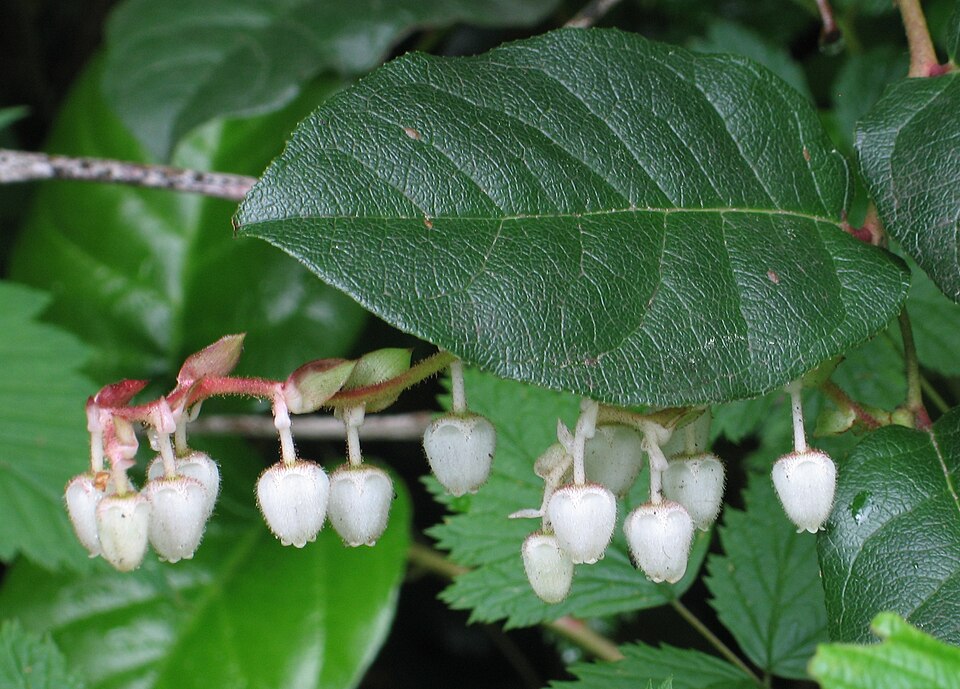
Salal bells nod in coastal wind. Pale pink promises of blue-black berries.

風物詩 · Fūbutsushi
Salal in bloom along a coastal forest trail in late May — rows of pale pink bell flowers nodding in the sea wind, the understory stretching on in every direction.
物の哀れ · Mono no Aware
The flowers will be forgotten by July. Even the berries will be passed over by most people, who will not recognize them as food. Salal holds its gifts quietly.
What the season brings?
Late May marks the flowering of salal (Gaultheria shallon), one of the Pacific Northwest's most ubiquitous native shrubs, with delicate pale pink bell-shaped flowers nodding along arching stems. These evergreen shrubs grow 1-6 feet tall (occasionally taller) and form the dominant understory vegetation in many coastal and lowland coniferous forests from Alaska to California. The small urn-shaped flowers, arranged in terminal racemes, attract native bumblebees and hummingbirds, while by late summer they develop into dark blue-black berries that were among the most important traditional foods for indigenous peoples throughout the region. Salal berries are sweet with a unique flavor and were eaten fresh, dried into cakes for winter storage, and mixed with other foods. The tough, glossy evergreen leaves are commercially harvested for the floral industry, making salal a significant non-timber forest product in the Pacific Northwest.
Convergence chain
Triggered by
Gaultheria shallon blooms in late May when soil is beginning to dry at the surface but deep moisture remains; its ericaceous mycorrhizae — shared with conifers — give it access to soil nutrients others cannot reach, allowing bloom even as neighboring plants show early drought stress
Enables
Salal flowers are visited exclusively by bumblebees with sufficient tongue length and buzz-pollination ability; berries ripen in August, sustaining black bears through late summer; dense evergreen cover is primary nesting habitat for rufous-sided towhees; salal's mycorrhizal network connects to the same Douglas fir root network as chanterelles — the salal bloom is a phenological signal that chanterelle mycelium is active below
The cascade
Salal blooms → bumblebee queens buzz-pollinate the urn-shaped flowers → berry development through July → August ripening coincides with bear pre-hyperphagia period → bears consume vast quantities of salal berries → seeds dispersed in bear travel corridors → the mycorrhizal network supporting salal is the same network carrying carbon between Douglas fir trees → salal's health is a proxy for the health of the entire forest soil food web
Foods to Mark the Season
Strawberry season is in full swing across western Oregon and Washington lowlands—early June-bearing varieties are at peak sweetness. Wild thimbleberries are findable along forest roadsides and clearings in the Olympics and Coast Range. Pacific halibut sport fishing is active on both the Oregon and Washington coasts.
Frequently Asked Questions
Visions of the Season
Read more
Each microseason is approximately 5 days, marking the subtle changes in nature throughout the year.