Hummingbirds Return
Hummingbirds Return
16/72: Mar 16 to 20
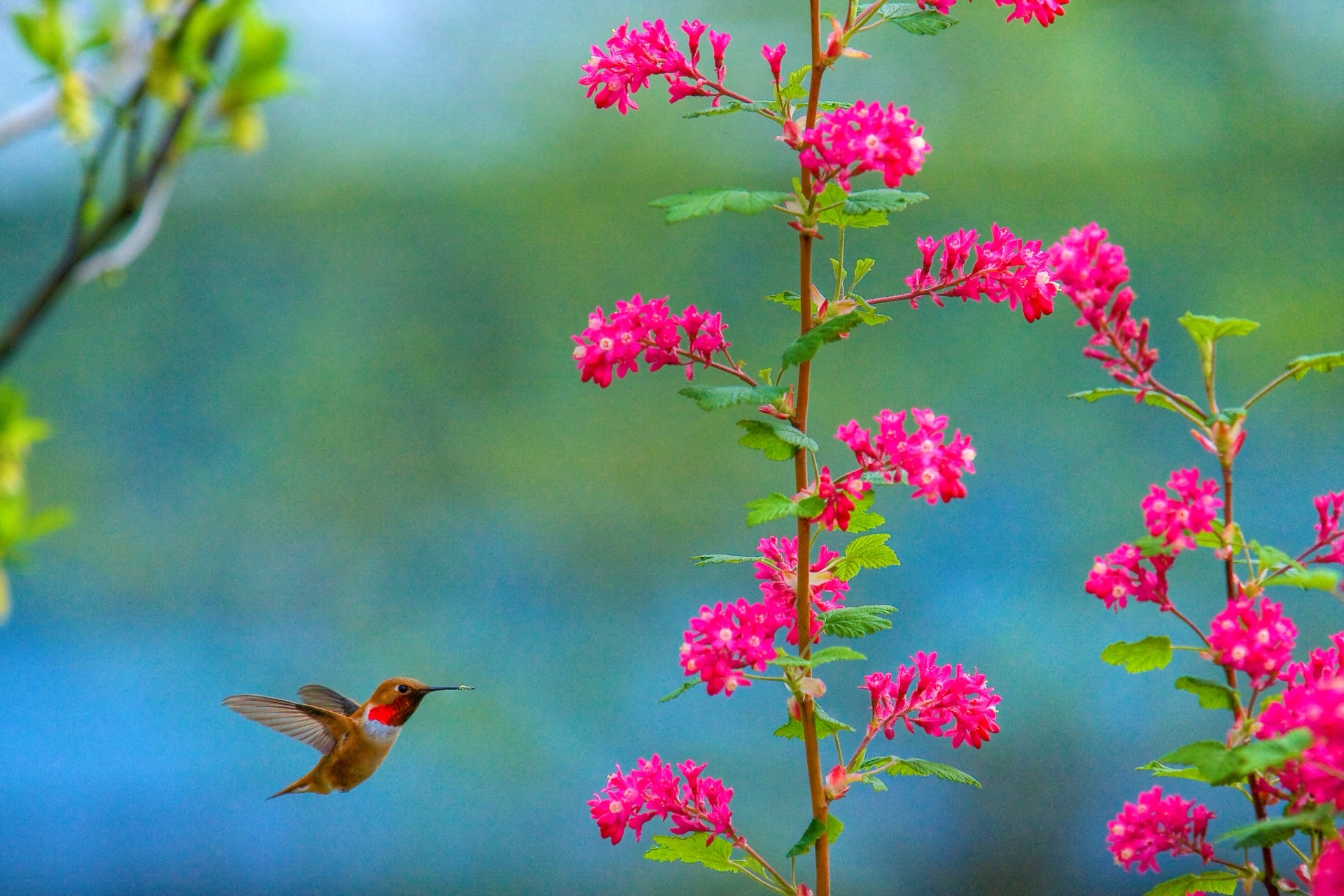
Hummingbird scouts return from Mexico. Rufous males seek the currant's red nectar.

風物詩 · Fūbutsushi
A rufous hummingbird scout arriving at the first red flowering currant of March — iridescent orange gorget flashing, 3,000 miles collapsed into this single flower.
物の哀れ · Mono no Aware
By August they will be gone south again, and the feeders will hang empty. The whole fierce summer presence reduced to a memory and a fading trail of flowers.
What the season brings?
Mid to late March brings the return of rufous hummingbird (Selasphorus rufus) scouts to the Pacific Northwest, with males arriving first to establish territories before females follow 1-2 weeks later. These tiny migrants travel over 3,000 miles from their Mexican wintering grounds, timing their arrival to coincide with the blooming of red flowering currant, their primary early-season nectar source. Male rufous hummingbirds display brilliant orange-red gorgets (throat feathers) and are highly territorial, aggressively defending flowering plants and feeders. Watch for their spectacular courtship displays, where males perform steep U-shaped dives, producing loud wing trills at the bottom of each dive. Rufous hummingbirds are among the longest-distance migrants relative to body size of any bird species, and their arrival signals the full awakening of Pacific Northwest spring.
Convergence chain
Triggered by
Rufous hummingbirds track the northward advance of flowering red tubular plants up the Pacific coast; their arrival in western Washington coincides precisely with peak red flowering currant bloom (Season 11: Currant Ignites) and the opening of early salmonberry flowers — a migration timing driven entirely by floral phenology rather than temperature
Enables
Rufous serve as keystone pollinators for Ribes and early Rubus; inter-male competition drives aggressive territory defense that paradoxically increases cross-pollination by forcing females to visit many separate patches; Anna's hummingbirds resident year-round are displaced by rufous aggression, driving dispersal into less-contested areas
The cascade
Rufous hummingbirds arrive from Mexico → males immediately establish territories at currant and salmonberry patches → aggressive chases between rufous males and resident Anna's spread pollen across wider areas than either species alone would cover → female rufous begin nesting in late March in conifer branches above blooming shrubs → nest material includes willow catkin down → nest placement timed to canopy leaf-out providing cover by egg-laying
Foods to Mark the Season
Morel mushrooms (*Morchella* spp.) begin emerging in riparian zones—look along sandy riverbanks near cottonwood groves, the classic Pacific Northwest yellow morel habitat. Fiddleheads remain widely available in damp woodland sites throughout the Olympics and western Cascades, and WDFW typically schedules razor clam digs around mid-to-late March on Washington ocean beaches.
Events This Season
Blaine, WA, mid-March. A three-day festival at coastal Whatcom County celebrating migratory birds returning from the south — field trips, wildlife boat cruises, expert speakers, and a birding expo at Birch Bay and Semiahmoo. The rufous hummingbird's first arrival in the Skagit lowlands is reliably recorded during this window.
events / washington / wings-over-water-birding-festival →Tofino and Ucluelet, BC, third week of March. A week-long coastal festival marking the gray whale migration past Vancouver Island's west coast — running in the same week the first hummingbirds appear inland. Whale watching, the Parade of Whales, and the Chowder Chowdown.
events / british-columbia / pacific-rim-whale-festival →Othello, WA, third weekend of March. The festival opens as the week begins — nearly 35,000 sandhill cranes are staging in the Columbia Basin cornfields, and expert-guided crane viewings, keynote talks, and photo contests fill the long March weekend in this Eastern Washington farm town.
festivals / washington / othello-sandhill-crane-festival →
This Season’s Podcast
The High Stakes Life of Rufous Hummingbirds
Rufous hummingbirds travel over 3,000 miles from Mexico, arriving just as the red flowering currant blooms. We follow their high-stakes return to the Pacific Northwest.
Frequently Asked Questions
Visions of the Season
Read more
Each microseason is approximately 5 days, marking the subtle changes in nature throughout the year.